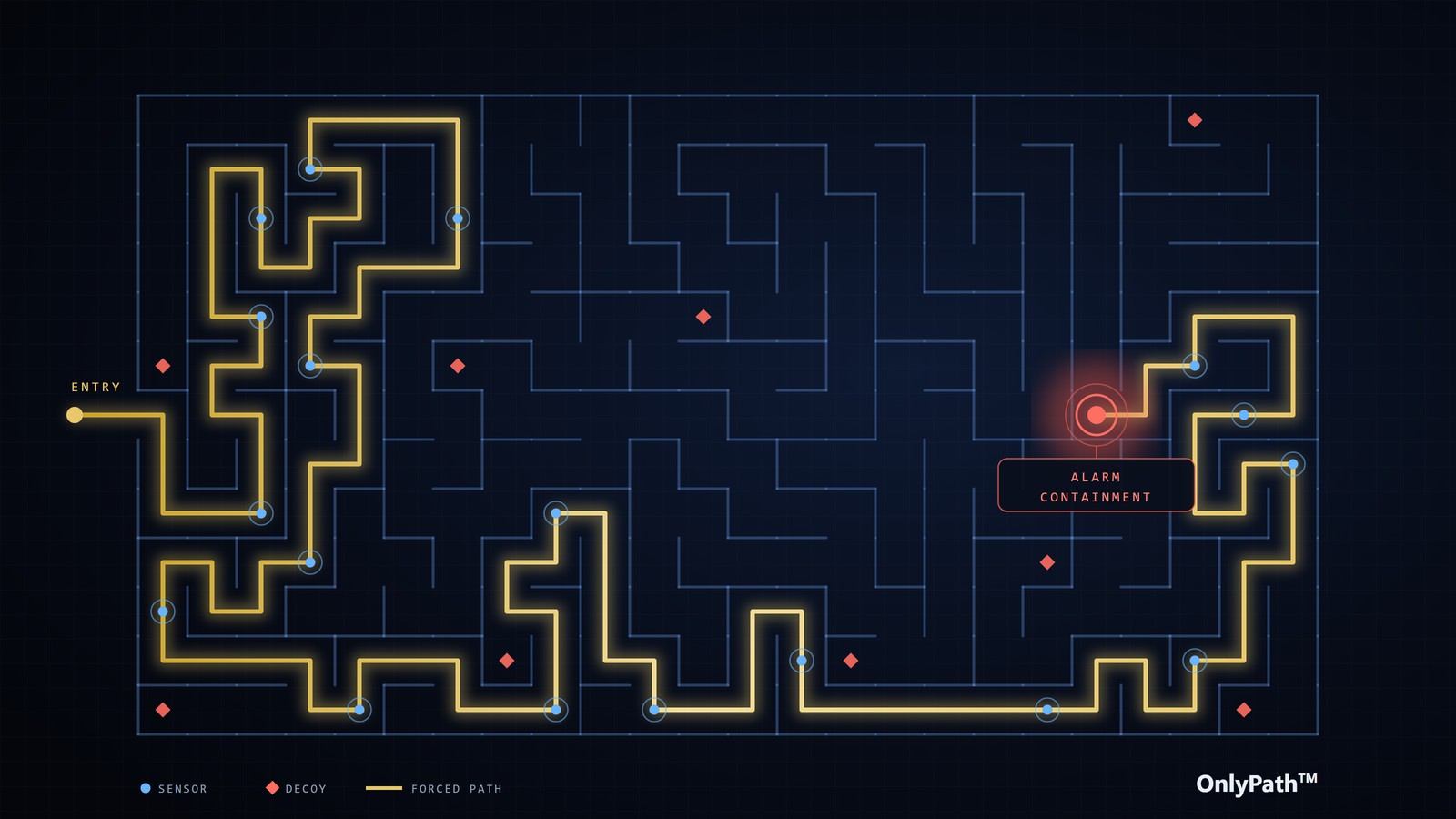
The only path is the one we draw.
Cybersecurity only works when the IT infrastructure is configured the right way. OnlyPath™ designs and configures the key components of your IT with an attacker's mindset: we draw the paths a criminal can take, so any incident is anticipated, visible and manageable.

In most infrastructures the paths to data and privileges are many, hidden and unwatched. Attackers find them before defenders do and, by the time the incident surfaces, it is too late to understand what happened.
We flip the perspective: we don't wait for the attacker, we prepare the path. And on that path, we are waiting.
Using offensive techniques, we identify every route an attacker could take to reach data and privileges.
We remove unnecessary routes and keep open only the ones we decide.
Sensors, logs and decoys along the way: every step the attacker takes becomes visible.
Playbooks, containment and backups ready: the incident is managed, not suffered.
"The only path is the one we draw."
The attacker can get in, but can only move along the routes we designed, watched by sensors at every point.
"We choose the battlefield."
Whoever chooses the ground wins before the fight: the network is designed so the confrontation happens where we are strongest.
"Every move the attacker makes triggers an alarm we set."
Decoy credentials, honeytokens and canary accounts: the more the attacker moves, the more they reveal themselves.
"Designed by a hacker. To stop hackers."
The configuration is led by offensive security experts, who know the attack paths because they walk them for a living.
"An incident is handled well only if it was anticipated when the IT was designed."
Logs, playbooks and backups ready before the emergency: you execute, you don't improvise. In line with NIS2 and DORA obligations.
"They get in. But only where we want them."
Every deviation from the expected path is a signal, and every signal maps to a decision that is already prepared.
You don't need more tools: you need the right ones set up the right way. That is what makes an incident manageable.
A tiered Active Directory: the possible paths are few, known and watched.
No shortcuts to the highest domain privileges.
Critical traffic passes where we concentrate control.
Tamper-proof: every step along the path stays visible and traceable.
Decoys that trigger the alarm at the first wrong step.
Configured against real attacks, not left on factory settings.
When the incident hits, you execute a plan, you don't improvise.
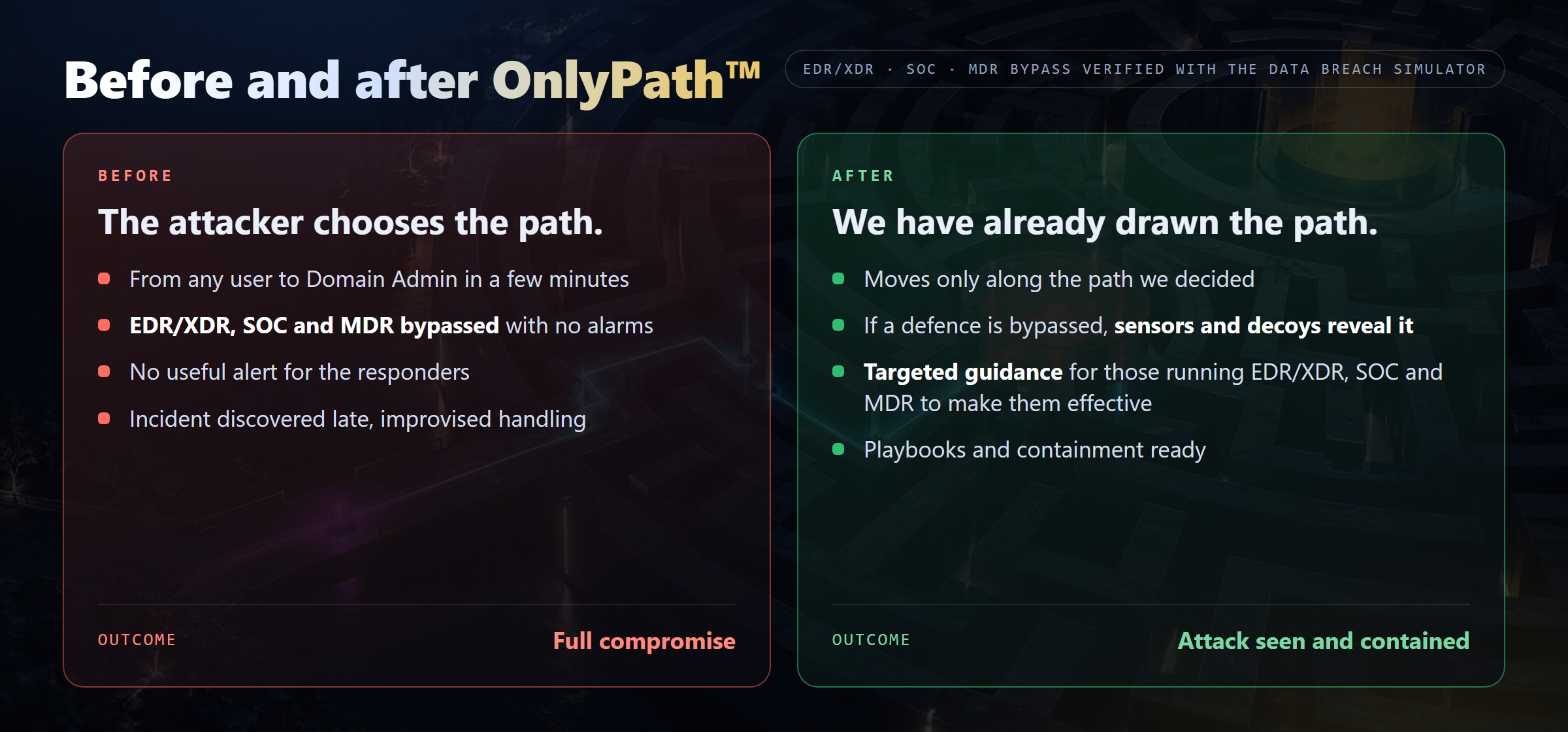
The Data Breach Simulator measures before and after: the same real attack, in a controlled environment, before and after the OnlyPath™ configuration. We also verify whether EDR/XDR, SOC and MDR can be bypassed, and give those who run them targeted guidance to make them truly effective.
Illustrative example. Actual results depend on the infrastructure and are measured for each client with the Data Breach Simulator.
Usually not. OnlyPath™ works mainly on the configuration of what you already have: Active Directory, identities, segmentation, logs, EDR/XDR and backups. If integrations are needed, we tell you, with priorities and reasons.
It means we design the infrastructure so that the routes to data and privileges are few, known and monitored. An attacker can still get in, but every move goes through points we control and that trigger the alarm.
Both require incidents to be prevented, detected and handled in a structured way. OnlyPath™ makes these capabilities concrete and demonstrable, with evidence that is also useful for audits and management bodies.
With the Data Breach Simulator: the same real attack, in a controlled environment, before and after the configuration. The comparison is objective and summarised in the Incident Readiness Score.
It depends on the size and complexity of the infrastructure. After the initial assessment we propose a plan with phases, priorities and timelines.
It is the method at the core of OnlyWay™ and it integrates with CISO advisory, data breach simulation and IT team training.
We design your IT infrastructure with an attacker's mindset, so every incident is anticipated, visible and manageable.